A year of concentration: FY2026 in review
Markets delivered another solid financial year — but the headline numbers hide just how narrow the winners’ circle was, at home and abroad.
Markets performed well in the fourth quarter to close out another solid financial year of investment returns. While the headline index returns appear strong, these numbers mask a significant amount of volatility and variance beneath the surface.
The dominant theme of the 2026 financial year was the concentration of market returns among a small number of stocks. This was most evident in the technology sector in the US, but also within the resources sector here in Australia.
Australian shares: a materials story
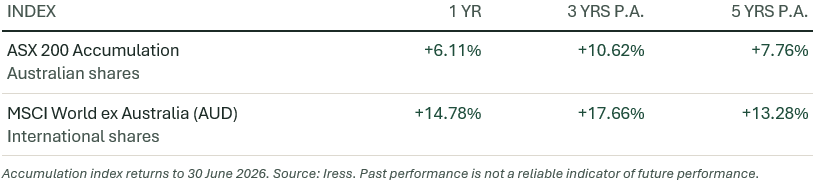
Australian shares returned +6.11% including dividends for the financial year, taking the 3-year return to +10.62% per annum and the 5-year return to +7.76% per annum. Beneath that number, sector performance was remarkably lopsided.
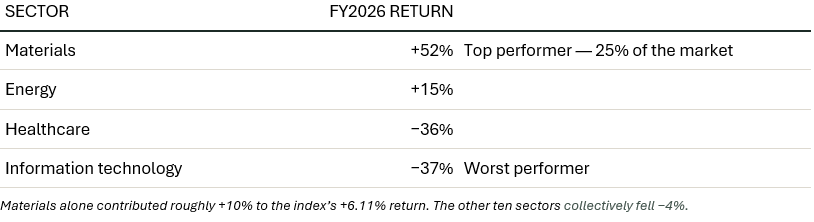
- Materials (+52%) and energy (+15%) were the top performing sectors; information technology (−37%) and healthcare (−36%) were the worst.
- Materials currently make up 25% of the overall market. It contributed approximately +10% to the index’s return, while the other ten sectors collectively fell by −4%.
- Simply put: if an Australian share portfolio or fund manager held less than 25% in materials, it would have been very difficult to match or outperform the market.
Periods of extreme concentration have occurred many times throughout market history. Over the long term, market leadership tends to broaden — creating opportunities for active investors to add value through disciplined stock selection and portfolio construction.
International shares: the AI scoreboard
International shares returned +14.78% for the financial year, taking the 3-year return to +17.66% per annum and the 5-year return to +13.28% per annum.
- In the United States (roughly 70% of the international market), sector performance was led by technology (+51%) and energy (+29%). Communication services were flat, making it the worst performing sector.
- Consistent with the broader concentration theme, a large portion of the market’s total return was driven by a handful of technology businesses benefiting from continued investment in artificial intelligence.
- Within AI, we’ve noticed attention shifting from mega-cap tech (Amazon, Google, Microsoft and Nvidia) towards a broader group of companies enabling the AI infrastructure buildout — memory chips, power management, networking equipment, data centre cooling systems and electrical infrastructure.
International fund performance this year was largely a scoreboard of the haves and the have-nots — measured by how much AI exposure they held.
Looking ahead: lofty expectations meet reality
AI remains one of the most important developments influencing global investment markets as we look to the 2027 financial year. While the long-term opportunity remains substantial, history suggests that periods of rapid innovation are often accompanied by shifting winners and losers as industries adapt.
The challenge for AI-related companies from here will be executing on the market’s current lofty expectations. Elevated valuations leave little room for error, and investors increasingly want to see evidence that these companies are generating a return on their AI investment. We expect this to remain a point of scrutiny in the months and years ahead.
A watchpoint: private credit
Beyond AI, we have concerns in some parts of the market — particularly private credit. Private credit refers to loans from non-bank lenders, issued at high interest rates, to riskier borrowers who weren’t otherwise able to secure bank funding. These funds have been raising large amounts of capital and offering high returns to investors, usually in the range of 8–10%.
A lot of private credit money in Australia has been loaned to property developers who are under pressure from recent federal budget changes, rising costs and higher interest rates. If developers can’t execute or sell their projects on time or on budget, private credit lenders are at risk of losing some or all of the money they loaned — with little they can do about it.
There has been a noticeable recent shift: several funds have been gating or scaling back redemption requests because they don’t hold the cash levels needed to pay out the large redemptions they’ve been receiving. We have feared this could play out for several years and have deliberately avoided private credit exposure.
These developments are early stage, but growing with each new story about a property developer going bankrupt or a fund restricting redemptions. It won’t affect every private credit fund — as in any industry, there are good and bad operators — but we do spend time considering the flow-on effects that continued issues in private credit could have on other parts of the market.
Our approach remains unchanged. We stay focused on identifying quality investments at attractive valuations that we believe will generate strong returns over time. While short-term market movements are difficult to predict, a diversified portfolio and a disciplined investment approach remain the most effective way to navigate changing conditions. As always, we thank our clients for their continued trust and look forward to working with you in the year ahead.
If you have any questions regarding this update or your portfolio reports, please contact your Investment Advisor. This update is general information only and does not take into account your personal objectives, financial situation or needs.